Gallery
Photos from past sessions.
On The Measure of Intelligence
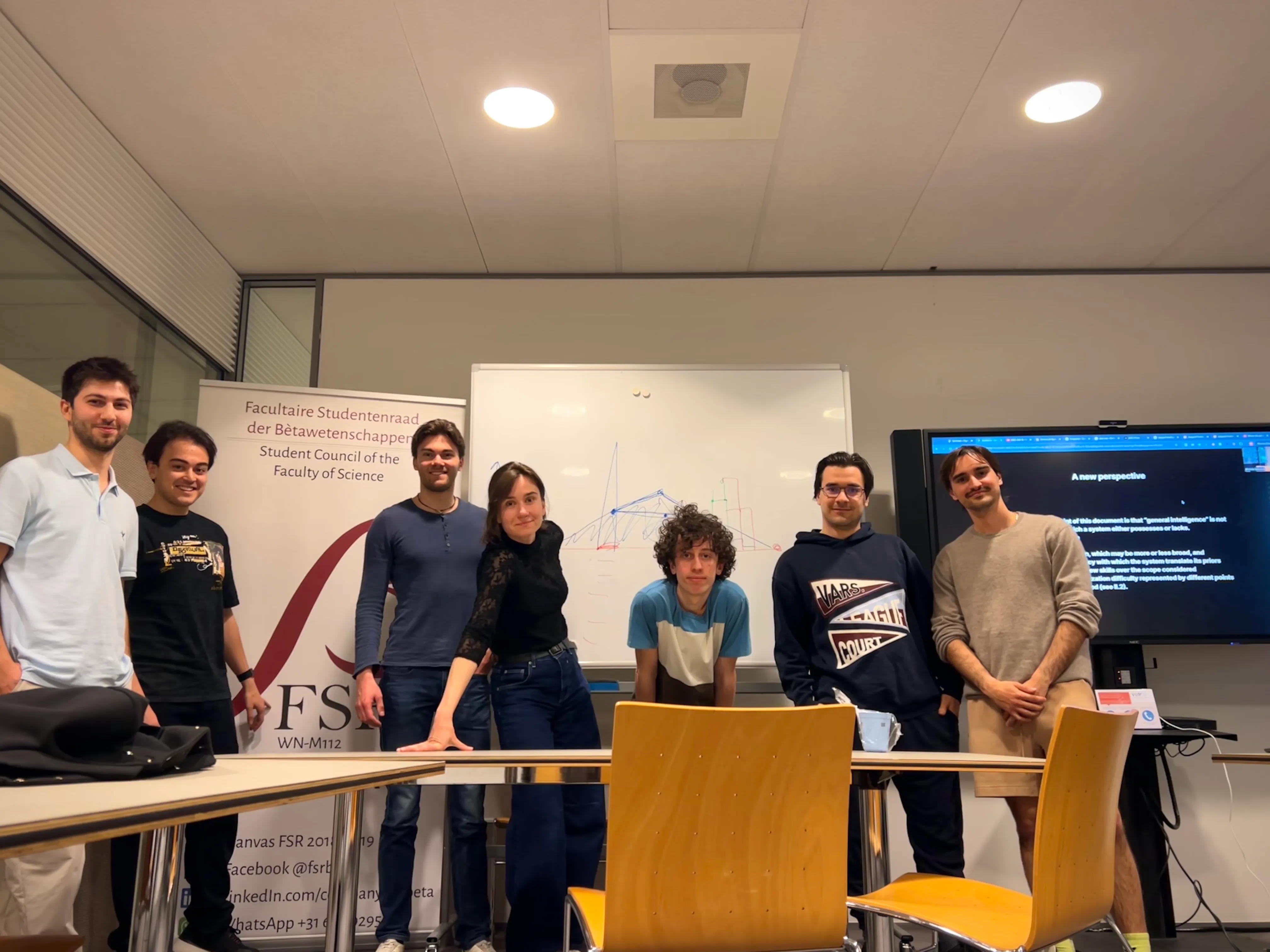
We are going to get started with something “easier” but important, which will serve as the foundation and north star for our future discussions.
The context
Recently, the ARC-AGI-3 Benchmark has been released. It should be a reliable way to score the intelligence of an LLM on unseen tasks. The interesting aspect is that these tasks, which are simple 2D games, are easily solvable by a human player. On the other hand, state-of-the-art models can only win 0.2% of the games on the private dataset (https://arcprize.org/leaderboard).
The person behind the benchmark, François Chollet, has been famously pessimistic regarding the efficiency and intelligence of transformers or gradient descent-based models. More importantly, he has been an advocate for new effective benchmarks to measure the generalization capabilities of these models. The ARC-AGI 1 and 2 benchmarks were, in fact, only solved when new paradigms were introduced, such as CoT and RL-trained reasoning, respectively.
The reading 📄
To better understand the need for these benchmarks, which ultimately guide AI progress, I propose we read this paper Chollet wrote in 2019. Here he provides a new perspective on the oldest problem in AI: “how do we define intelligence?”, which is extended to the question “how do we measure it?”.
Link to the paper: https://arxiv.org/abs/1911.01547 Read Chapters I (~1h) and II.1 (~35min). There is no math in these parts and it reads smoothly. Feel free to read chapter II(it provides a more technical definition of intelligence) and III (introduces the ARC-AGI benchmark) fully, if you have time and interest.
An animated discussion between François Chollet and Dwarkesh Patel. The first believes that current AI systems are not truly intelligent and that we need to rethink our approach to building them. Dwarkesh, instead is more optimistic about the potential of transformers and believes they only need to be scaled further.
DeepSeek-R1: Incentivizing Reasoning Capability in LLMs via Reinforcement Learning
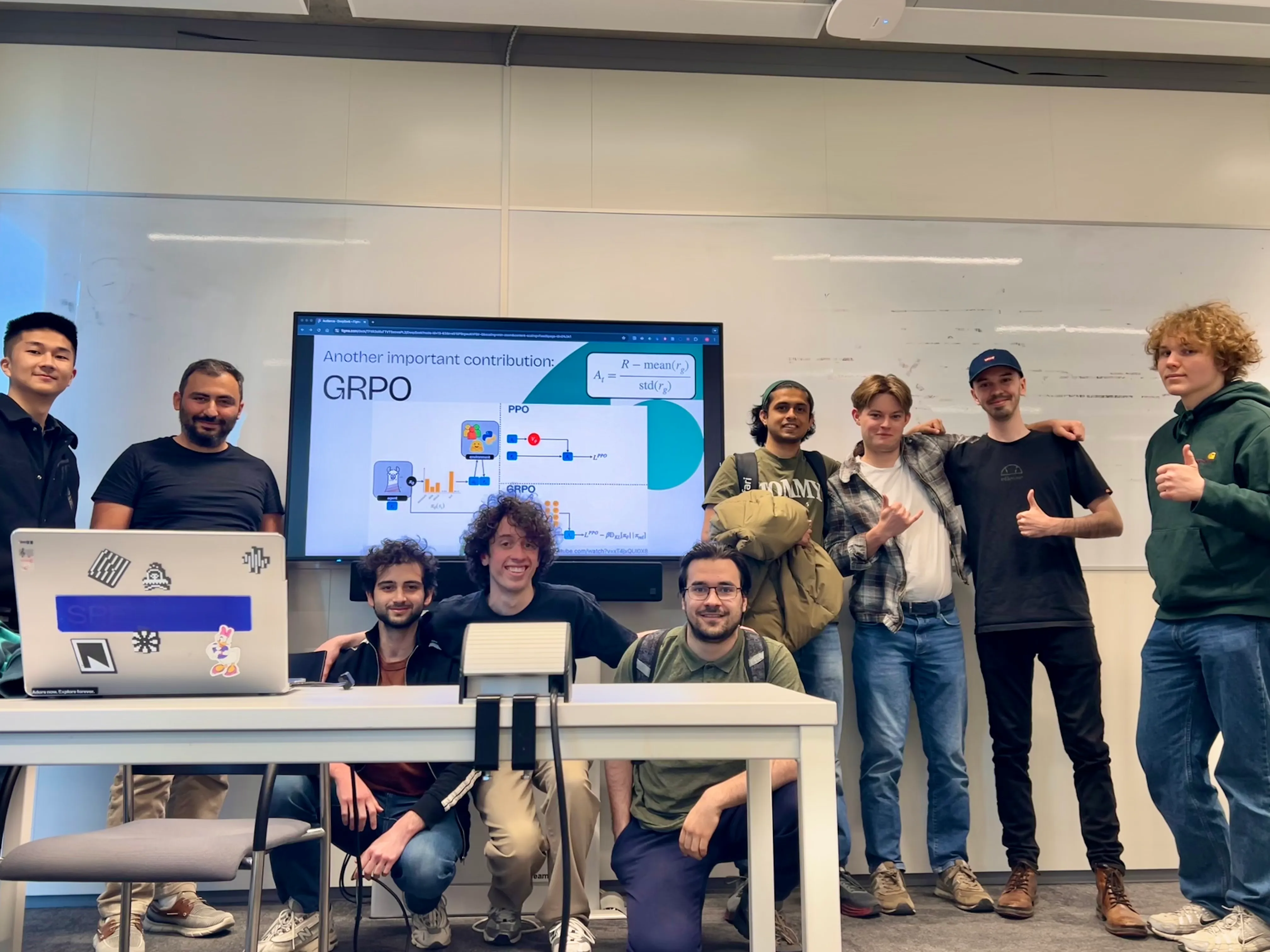
A key paper that demonstrated the usefulness of RL for eliciting reasoning capabilities in LLMs, trading compute for more data. Importantly, they introduce a new efficinent RL algorithm, GRPO, building on OpenAI’s PPO. This enabled the DeepSeek research team to train a model with capabilities close to the frontier with much less compute than US labs, giving a glimpse of hope to the rest of the world that it is possible to train SOTA models with limited resources.
Demonstrates how reinforcement learning (without supervised fine-tuning on chain-of-thought data) can elicit strong reasoning capabilities in LLMs. A key paper for understanding the current push toward reasoning-capable models.
An accessible video breakdown of DeepSeek's research and what it means for the field.
When AI builds itself
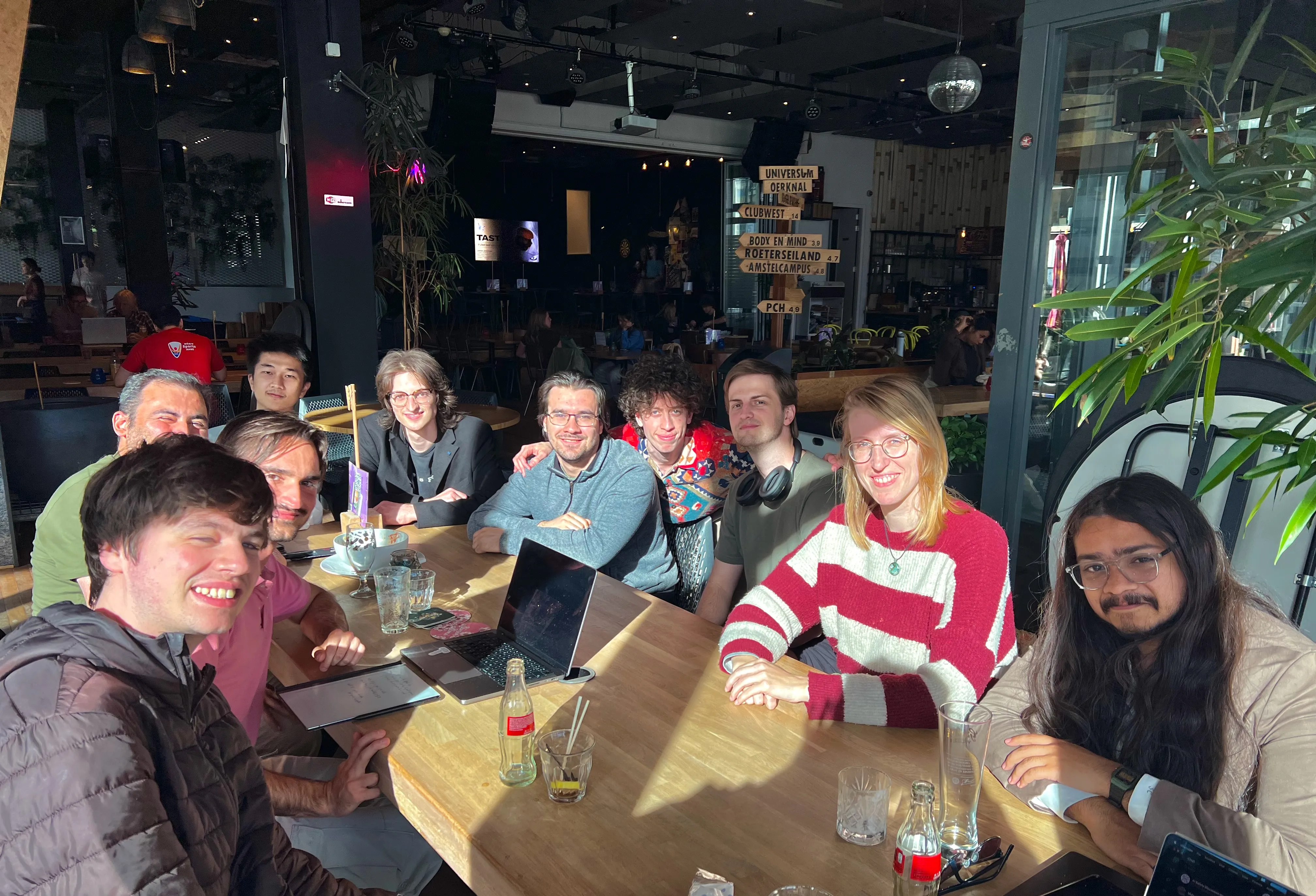
This week’s discussion is in collaboration with Safe AI Netherlands.
📍 We’re meeting at Oerknal in Science Park (UvA), this Wednesday at 5:30 PM.
📄 The reading is Anthropic’s new blog post — no background required (~30 min read). It looks at the current rate of AI progress, and in particular how far along we are on the path to fully automated self-improvement (AI that can independently do AI research), while addressing existential safety concerns.
All are welcome! 🌸